Web cookies (also called HTTP cookies, browser cookies, or simply cookies) are small pieces of data that websites store on your device (computer, phone, etc.) through your web browser. They are used to remember information about you and your interactions with the site.
Purpose of Cookies:
Session Management:
Keeping you logged in
Remembering items in a shopping cart
Saving language or theme preferences
Personalization:
Tailoring content or ads based on your previous activity
Tracking & Analytics:
Monitoring browsing behavior for analytics or marketing purposes
Types of Cookies:
Session Cookies:
Temporary; deleted when you close your browser
Used for things like keeping you logged in during a single session
Persistent Cookies:
Stored on your device until they expire or are manually deleted
Used for remembering login credentials, settings, etc.
First-Party Cookies:
Set by the website you're visiting directly
Third-Party Cookies:
Set by other domains (usually advertisers) embedded in the website
Commonly used for tracking across multiple sites
Authentication cookies are a special type of web cookie used to identify and verify a user after they log in to a website or web application.
What They Do:
Once you log in to a site, the server creates an authentication cookie and sends it to your browser. This cookie:
Proves to the website that you're logged in
Prevents you from having to log in again on every page you visit
Can persist across sessions if you select "Remember me"
What's Inside an Authentication Cookie?
Typically, it contains:
A unique session ID (not your actual password)
Optional metadata (e.g., expiration time, security flags)
Analytics cookies are cookies used to collect data about how visitors interact with a website. Their primary purpose is to help website owners understand and improve user experience by analyzing things like:
How users navigate the site
Which pages are most/least visited
How long users stay on each page
What device, browser, or location the user is from
What They Track:
Some examples of data analytics cookies may collect:
Page views and time spent on pages
Click paths (how users move from page to page)
Bounce rate (users who leave without interacting)
User demographics (location, language, device)
Referring websites (how users arrived at the site)
Here’s how you can disable cookies in common browsers:
1. Google Chrome
Open Chrome and click the three vertical dots in the top-right corner.
Go to Settings > Privacy and security > Cookies and other site data.
Choose your preferred option:
Block all cookies (not recommended, can break most websites).
Block third-party cookies (can block ads and tracking cookies).
2. Mozilla Firefox
Open Firefox and click the three horizontal lines in the top-right corner.
Go to Settings > Privacy & Security.
Under the Enhanced Tracking Protection section, choose Strict to block most cookies or Custom to manually choose which cookies to block.
3. Safari
Open Safari and click Safari in the top-left corner of the screen.
Go to Preferences > Privacy.
Check Block all cookies to stop all cookies, or select options to block third-party cookies.
4. Microsoft Edge
Open Edge and click the three horizontal dots in the top-right corner.
Go to Settings > Privacy, search, and services > Cookies and site permissions.
Select your cookie settings from there, including blocking all cookies or blocking third-party cookies.
5. On Mobile (iOS/Android)
For Safari on iOS: Go to Settings > Safari > Privacy & Security > Block All Cookies.
For Chrome on Android: Open the app, tap the three dots, go to Settings > Privacy and security > Cookies.
Be Aware:
Disabling cookies can make your online experience more difficult. Some websites may not load properly, or you may be logged out frequently. Also, certain features may not work as expected.
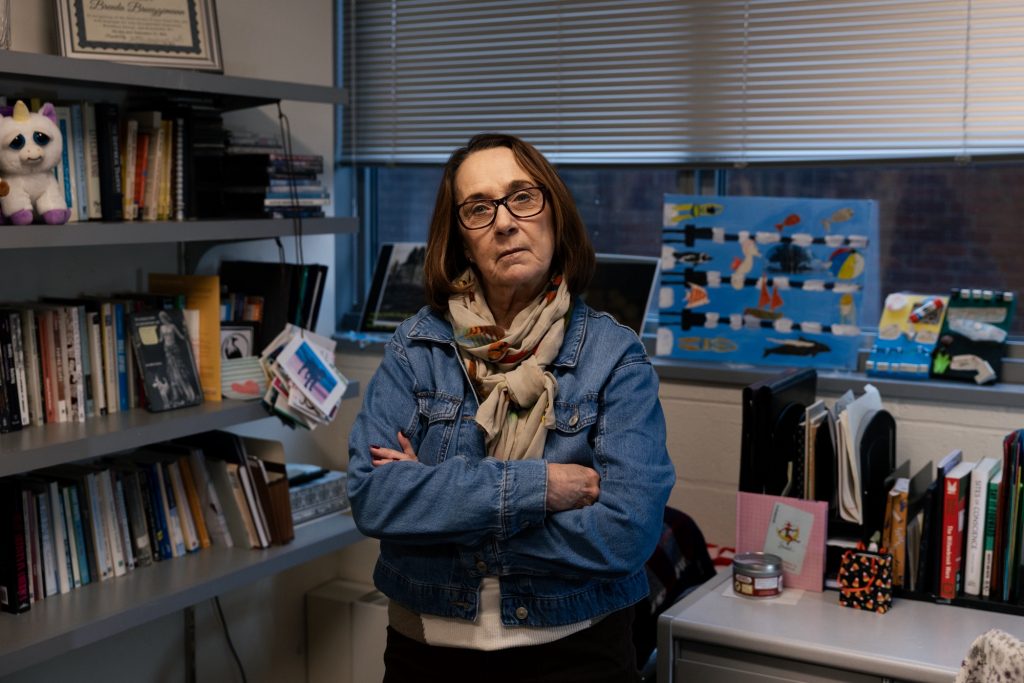
On November 9, 2025, journalist Emilia Otte published a feature in The CT Mirror examining the history and legacy of the Mansfield Training School. The article follows the work of UConn English professor Brenda Brueggemann and her students as they piece together the school’s complicated past. The team has worked to ensure this history is not forgotten through the building of this memorial website, the collection of oral histories, and countless hours of archival research.
Otte situates Mansfield Training School in the broader history of disability institutions across the United States. The school’s story is traced through its origins in the mid-1800s to its closure in 1993. But the piece also highlights the importance of lived experience through stories from former workers and family members.
This article explores the reality of institutionalization and the continuing efforts to ensure that this history is preserved and passed onto future generations.
Written by Hannah Dang with support from the DAC Team
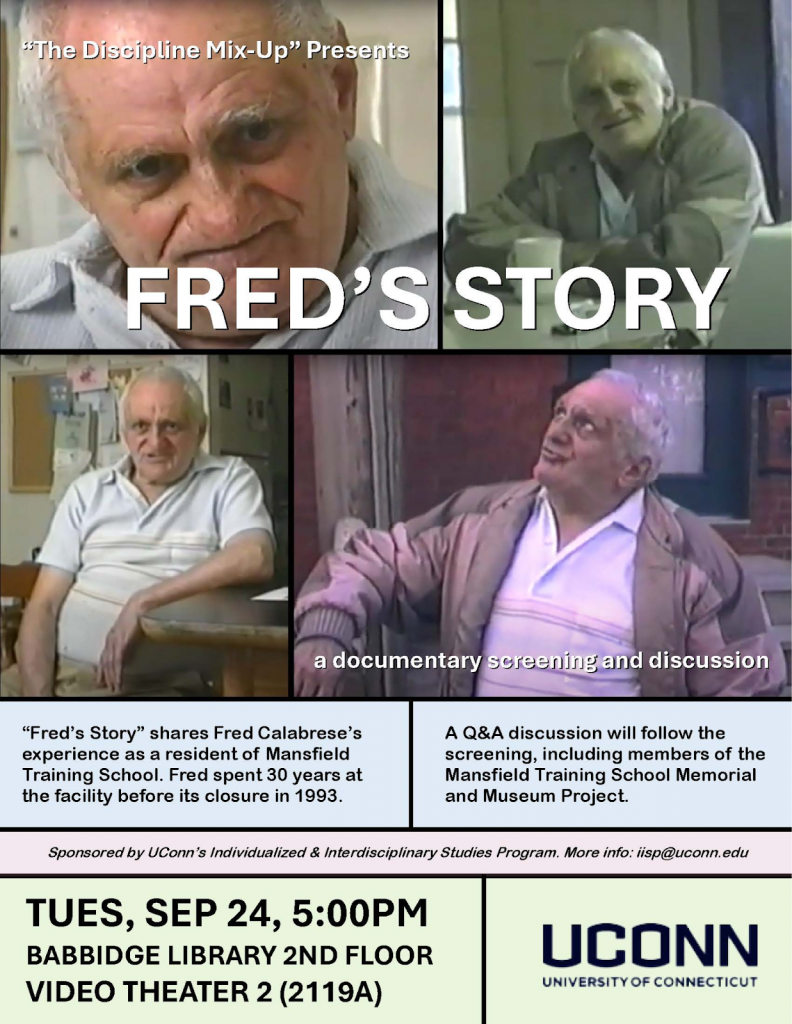
Caption: A poster promoting the documentary screening and discussion on “Fred’s Story” at the University of Connecticut. The poster has four different pictures, from varying angles, of an elderly man named Fred Calabrese, a man who was institutionalized at the Mansfield Training School.
Dim the lights. Lower our voices.
And allow the music, a fanfare of brass from the former Mansfield Training School band, to surround us, filling up the space, ejecting us back to the mid-twentieth century.
Sponsored by UConn’s Individualized and Interdisciplinary Studies Programand hosted by Ken Cormier, on the second floor of UConn’s Homer Babbidge Library, in the cozy video theater, we enjoyed a live film screening of “Fred’s Story.” The documentary was filmed and produced by Eric Neudel in 1996, three years following Mansfield’s closing, on the lived experiences of Fred Calabrese, one of the residents at Mansfield Training School. Following the 27 minute group watch, the presentation shifted to a Q&A discussion, featuring three interdisciplinary panelists. The panel members were: Ashten Vassar-Cain, a UConn graduate student majoring in Human Rights and an advocate for disability justice who has been a member of the Mansfield Training School Memorial and Museum Project for two years (and co-founder of the DAC blog); Nadia Scott, a UConn doctoral student majoring in History and an independent curator and writer focused on visual culture, nature building, and citizenship in America; and Kathryn Hanewicz, a social worker and the current director of Southbury Training School in Connecticut.
The documentary was based on the true story of Fred Calabrese and the state of living he experienced for forty years after being sent to the Mansfield Training School, an institution in Connecticut. He recapped the harsh realities and living conditions at Mansfield including details which weren’t limited to: sweltering heat, unsanitary and tightly-enclosed living spaces, not being allowed outside, and being assigned a guard 24/7. By the time Fred left Mansfield and regained his freedom and autonomy, he eventually obtained an apartment of his own and a new job with supportive co-workers. That was when Fred was approached by Eric Neudel to create a film production on his time at Mansfield and his life afterward.
At the end of the film showing, the three panelists were asked to speak on their reactions and research regarding “Fred’s Story.” I had a lot of thoughts after watching the film and attending the panel. Down below is a curated list of some of my thoughts.
One of the panelists brought up the notion that while Mansfield Training School was closed, we have to understand the construction of training schools was not a singular incident. Even now, the inhumane practices of these “schools” happen to people with disabilities on a global scale because their rights are always confiscated. As we sadly saw in the form of personal stories, including Fred’s, human rights did not always apply to disabled people, and the medicalization of disability restricted people’s rights.
One of the panelists revealed some of the residents’ medical histories were located in Archives, but the information was either redacted or restricted. In other words, it was not accessible due to HIPPA privacy protection laws. As such, we should consider ourselves extremely lucky to have “Fred’s Story” because not everyone has the opportunity nor the privilege to tell their side of the story. People may interpret the purpose of “Fred’s Story” to be countering the misunderstandings and misinformation regarding institutionalized residents as well as criticizing the Mansfield Training School. While the film depicted Fred’s life accurately, we also need to watch the film critically: “Fred’s Story” only represented one perspective of institutionalization. There were other residents who were at Mansfield for longer, for decades, since childhood, and many even until death. This doesn’t discredit “Fred’s Story” per se, but we do have to keep in mind there are parts of the story we’ll never see.
The floor was then open to questions, and one of the members of the audience brought up UConn’s failure to install a memorial for the Mansfield residents and asked about the specifics in regards to UConn not taking accountability. A bunch of answers sprouted forth. According to the panelists, there were proposals on what to do with the property after Mansfield’s closing, but as of late, there are no plans being implemented. At some point, the building was reused as a prison, but due to contamination and the owners’ neglect, the building closed down again. Even in the present, information on the training school was limited, and someone else in the audience said that not much survived after the building closed down.
We can ask ourselves if there are any possibilities of using and repurposing training schools and to what capacity. After all, we have to remember we cannot always blame the architects of the buildings or the people who worked at the facilities, but the superiors behind-the-scenes are the ones responsible for burying the matter of the Mansfield Training School’s existence. Just as we can’t access the residents’ medical histories, we don’t have the backing to fully research the layout of Mansfield. Both are a form of erasure. We can’t insert our own narratives or rewrite history.
If disabled people are constantly being oppressed and deprived of our rights as human individuals, we then have to ask ourselves the following: “How do we empower each other?”
My answers:
We integrate our values.
We hear, accept, and empathize with people’s stories, the beautiful and the “ugliness.”
We have a multidisciplinary understanding.
We acknowledge it as a part of human history.
We recognize the importance of our lived experiences.
That is how.
Fred Calabrese and “Fred’s Story” were the manifestation of what it means to value a human life. Something we can learn from Fred is the way he unabashedly cherished his workplace and prioritized the friendships he sparked with people. As pointed out by one of the panelists, in the film, we see Fred was always introducing people at his office to the cameramen. At Mansfield, Fred was isolated and his needs were ignored. As such, Fred’s efforts toward ensuring every one of his co-workers and friends are recognized speaks volumes about the legacy Fred wanted to leave behind: a message of hope and resilience. One of the audience members met Fred in-person and said he was one of the friendliest and strongest people she ever met, testifying that Fred was a one of a kind person who deserved better than the mistreatment he experienced at Mansfield.
Advocating for our rights and for the rights of others is our greatest weapon and shield. This is the time to determine the value of humanity and challenge authority that seeks to diminish our prosperity. For the longest time, we were never allowed to have conversations on disability advocacy and institutionalization due to stigmatization.
But now, in this moment, we have to pay attention to the history of this neglect and transform that predetermined narrative to a chapter written by and belonging to us.
Gratitude is a powerful feeling. It can be based on how you are treated, how you perceive the world, and how you see yourself. Gratitude can come from a present time, past event, and “anticipatory gratitude” of the future. While visiting the Willowbrook Archives, I experienced all three tenses in just 48 hours. On June 17th, Professor Brueggemann and I visited the College of Staten Island. I was amazed that a place which felt so familiar, could also feel foreign at the same time.
I was born and raised in Staten Island. I have attended numerous events at CSI and have often heard about the offerings and deep history that the school holds. I have also heard many (vague) stories about the Willowbrook institution. I knew it existed, was a bad thing, and was shut down when the “badness” was revealed. I describe my knowledge this way because I now know how bare minimum my understanding was.
Professor Brueggemann and I had the opportunity to get a “walkthrough” of part of the Willowbrook Mile from historians, Dr. Catherine Lavender and Dr. Nora Santiago, the Willowbrook Legacy Project co-directors. They walked (and rolled) us to some of the markers on the trail and shared their experiences of creating the WM and any history that they felt was notable to share. They told of the horror stories they have heard, especially from a staff member from Willowbrook. They described the documents they’ve read, images they’ve seen, and the hidden details that Staten Island’s “rich” history has buried deep in the archives.
While passing a main area on CSI’s campus, I was quickly brought back to a memory of the theatre center where I used to have recitals for my dancing school as a child. This building now had a WM marker in front of it. I was struck with such surprise that I had been surrounded by this history then, but I had no idea. Making this connection was my first major moment of past gratitude during our visit.
The following day Professor B and I attended a rally to advocate for the government to keep their “hands off Medicaid”. We gathered in front of a building which stores the Willowbrook Archives. This is also the location of the first WM marker, which is angled to face the area of the building where these archives are. I was surrounded by 200+ people, all with varying connections to disability. For example, some were individuals with intellectual disabilities that came with friends and family, some were members of group homes, some were family members of residents of Willowbrook, some were Medicaid users (like me), and some were advocates because of their professions related to disability (also like myself). Although we were attending the rally for different reasons, we were all there to fight for our lifelines, our Medicaid benefits. Being surrounded by this passionate energy initiated my present gratitude for the strength of this community during this trying time.
Gabby at a rally, advocating to protect Medicaid.
After the rally, Professor B and I (and my mom) went into the library and up to the second floor to the Archives and Special Collections area. Initially, I thought the experience would be like visiting the CSL Archives. The air was chilly and felt aged, like a childhood bedroom that has been untouched for many years. I had a lot of built-up tension from the anticipation of sifting through this new material, the awkwardness of having my mom join us on this visit, and the struggle of trying to separate my mind from the concluding rally just outside. As we settled down at the table and opened the first set of documents, I felt my mind dive headfirst into the material. I began painting a story in my mind of what Willowbrook was like.
Gabby in her wheelchair, looking down at the documents in her lap. Professor Brueggemann’s laptop and notebook are partially seen in the bottom right corner of the image. Gabby is holding her head up with her hand, while her face is scrunched and deep in thought from reading. She is wearing a black T-shirt, with a drawing of Judy Heumann holding a protest sign that says, “Disability Rights Now”. The text to the right of the drawing is a famous Judy quote in purple lettering that says, “If you don’t demand what you believe in for yourself, you’re not gonna get it.”
Me trying to immerse myself in the reading and imagine life at Willowbrook.
As a disabled individual, I have had to learn to advocate for my abilities, my rights, and my independence. However, despite the progress in our world, there are many instances where the systems in place or people of power assume that I am not capable of this on my own. Although my experiences are not nearly as extreme as how individuals were treated at Willowbrook for far too long disabled people have been excluded from discussions and decisions about their lives. Reading the ways that the residents were described and seeing the compilations of files highlighted the accessibility that we have today.
The more I read, the more I was reminded of the immense gratitude I have for my lifestyle. For instance, after our visit with the Willowbrook Archives, I took an accessible Uber to lunch at an accessible restaurant, then used the accessible bathroom there, and finally, took an accessible city bus home. I am endlessly grateful for the level of accessibility in our modern world. I do not mean access in just the “structural” sense, but also in the way that society treats disabled people, especially the United States. Although disabled people still lack many equal rights, the world has gradually become more inclusive and sees that we (disabled people) are to be treated with the same value, dignity, and respect as any other person.
I had a busy few days leading up to my visit to the Archives, so my mental battery was draining lower than my power wheelchair’s battery. I had just finished my junior year, travelled home independently for a disability convention, returned to UConn with my mom, packed away my dorm for the summer, and worked a double shift in my kitchen job the days prior. Entering the parking lot of the Connecticut State Library, I could tell this was going to be a deepened experience. The rusty gate creaked open while a piercing, ringing alarm sounded to alert of my entrance. I was greeted by Damon Munz, a Government Records Archivist, into a large conference room with rows of tables and a group of people reviewing documents in the far corner. The air smelt aged from the stacks of boxes scattered through the space. It reminded me of an old newspaper that my mom has saved with a favorite recipe. The pages have curled on the edges and some of the ink has smudged away. Although visually it has faded, the quality of the recipe and the meaning it has for my family will always remain. The CSL environment had this same reminiscent feeling. When it came time to start sorting through our selected archival materials, I felt like a detective searching for clues. However, this detective was not prepared for the shocking discoveries she would make.
Throughout the archived materials, there were two common themes: (1) disabled people were spoken about, rather than to, and (2) disabled people were described like burdens to their families and those around them. The first theme reinforces the (false) idea that disabled people do not deserve the same rights as their nondisabled counterparts. The Mansfield Training School – along with other institutions in that time – often describes disabled people like they are responsibilities and not people. This is especially seen with the second theme. Some of the archived materials, such as a weekly newsletter from MTS, describes caring for a disabled person as exhausting. This example was sharing about a respite program to relieve family members of their duties temporarily, so they can “recharge” to continue caring. The terminology in this example made it seem like a family should feel and say, “My [family member] is such a burden to my life, but if you give me a little break, I guess I can tolerate them.” These respite programs were seen as a positive thing because they were a way to keep the disabled individual in their home and with their family. However, this does not consider how dehumanizing and disrespectful this was to disabled people, and even to their families. Although these respite programs still exist today, (my family and I use it) they are run and organized in a much more dignified manner. The purpose of them is to help the individual continue to work towards their life goals and to relieve a parent or guardian of these parental duties. Although the service being provided is similar, the approach and presentation of the program is completely diXerent.
During our time at CSL, we also had the opportunity to see the full collection of archived materials from MTS. We entered an oXice space that transitioned into a factorylike display of countless boxes of archives. Some boxes held medical documents, administrative materials, legal files, etc. When Damon led us to the MTS section, the archives looked aged. Many boxes were restricted; each filled with stories that are trapped like spirits waiting to be set free. Disabled people are already restricted by the inaccessibility and ableism that society creates for us, we cannot restrict these spirits’ stories too.
Rear-facing view of Gabby in her wheelchair. She is driving through an aisle of the Archives. There are tall shelves filled with yellowed filing boxes, with florescent lights shining down on them. Gabby is looking up at boxes as she rolls through.
Side-view of Gabby on the far left. She is sitting in her purple power wheelchair, scanning through yellowed documents. There are more documents scattered on the table to her right, as well as an open laptop. Hannah, Gabby’s student research colleague, is on the far right, typing on her pink laptop. Both look deeply engaged in the materials
Caption: A segment of MTS Superintendent Neil A. Dayton’s “Standard Procedure Runaway Girls and Boys.” It reads: “It is unfortunate that a few boys and girls can make so much trouble and cause many others to be corrected who are not to be blamed. If you wish to help in this matter and keep your building out of trouble, do two things: (1) Stop or catch any boy or girl running away. (2) Report any runaway plans to your Charge Attendant at once.”
Written by: Hannah Dang
One of my favorite pastimes is cleaning.
One of the first things I do after I wake up–and after doom-scrolling on Instagram and YouTube–is make the bed. I tug at the thin sheets and then the thick comforter till each edge aligns perfectly with every corner of the bed. Fluff one pillow, and then place it on top of the other. I pick up the stuffed animals that fell on the carpeted floor and neatly arrange them on my bed.
I don’t–I can’t– leave it all behind until everything’s exactly how it should be, everything in order.
I like soaking soap-sudded dishes in steaming water. I like to breathe in the heat of freshly cleaned laundry. I like the way the pool rumbles affectionately as I flip the switch to the filters on. I like to hear the way the kitchen counters squeak in delight as I scrub each surface down.
Even as I write, the echo of people calling me a “neat freak” rings in my head, but it’s a skin I’ve grown into. It’s not my fault that there are very few things that annoy me more than someone leaving a used cup behind. The urge to clean, it lingers like an uncontrollable itch.
It’s no surprise that I self-appointed as the “clean-up crew” for this project (I say this with great enthusiasm). At the same time, it’s quite fair to say that I’ve never cleaned anything as thoroughly as the files on the Mansfield Training School.
It’s an experience I can’t describe lightly. Unlike cleaning my house, cleaning up the files is a different kind of cleaning to become accustomed to. As soon as I open the files, I can’t decide if I am working with a blank canvas or restoring what’s already there, what’s left. For hours on end, there’s cataloguing. There’s reorganizing. There’s renaming. There is the occasional chuckle as I stumble upon another undecipherable document, another blurry photo, or another expired link.
And there’s the pang in my heart as I read another caging line.
I don’t really know what to feel when I read such stories, or if there’s something I’m supposed to feel. Most of what I read are administrative documents, detailing the superintendents’ policies, the finances, the publicity of the school’s rise and fall, but it felt impersonal to have access to it. I felt like I was intruding on someone’s history.
This was someone’s else’s past, someone else’s pain, someone else’s memories that I’m piercing together.
These were people’s lives. Real, living people. I read about the way residents attempted to run away only to be caught and restrained for hours, even days. I read about their plans to euthanize the residents, wiping them out of the human race. I read about the names they were all called simply because of the way they looked or what they were born with, and it hurt every single time.
Because I can’t help but feel fragile in such moments, I shut down the laptop, stretch, close my eyes, and rest in the quiet. Even if I know what I’m doing is for a greater good, for a purpose, I’m someone who needs to practice some self-loving in my work routine.
People have more reasons than one to like cleaning, but I think one of the most important is the space it clears and provides, a time to create a new clean slate to grow and reflect in. Even something as omniscient as history understands that preserving time takes time. Unlike the bed I make every morning, I have to remember it’s okay to leave the files disorganized every once in a while, but I will always return to finish it.
That’s the love in cleaning what’s left, and the love in restoring what’s lost.
Based on our visit to the Connecticut State Archives on May 6, 2025~
Caption: A photograph taken behind-the-scenes during Hannah’s and Gabby’s visit to the Connecticut State Archives. Both head down an aisle of towering marked cardboard and metal boxes containing all of the information collected on the Mansfield Training School.
I was born into a line of oral storytellers.
Ever since I was a small child and even now, my mother and her mother before her, loved to tell me stories, using their voices to transport me to universes beyond the walls of the dull town I grew up in. Other children learned about Santa Claus, who would bring presents to “good” children during Christmas Eve, and the Easter Bunny, who would hide chocolate eggs in people’s gardens to welcome the spring, but I went to sleep dreaming of faeries and dragons and kingdoms long fallen.
For as long as I’ve known, a drought has plagued my hometown. And my mother and grandmother showered every inch of land with stories and life like the dragons of old, voices as bright and as deafening as rain and thunder.
My younger sisters and I inherited their storytelling. Our stories were different, our voices softer than our mother and grandmother, resembling spring rain. At the same time, our stories were simply variations of what we knew and what we experienced. Most of our stories are told to make people laugh, and others cause people to shed tears.
I’m less of an oral storyteller than a writer now. I’m sitting across from my sister at her desk, inspiration ready to dance through my fingers. Laptop on the verge of dying, crumpled sticky notes thrown on the floor, pens leaking ink, body winded, breath heavy, my shoulders feel lighter, knowing I have the whole day dedicated to writing to look forward to.
Pages blank, there were many more stories lying in wait. The muscles in my hands release every bit of tension, stretching every finger in preparation to capture the clap of thunder and strike of lightning sparking in my brain, setting off a fire in my soul.
The story I’m about to write isn’t a story to read during the rain.
The fire in me is still burning.
From the moment Professor Brenda sent her email, asking Gabby and I to spend a day with her at the archives to have a hands-on experience with the artifacts, I wasn’t sure what to expect. I’ve played the role of a “historian” on my own time, watching YouTube shorts on timeless paintings or becoming obsessed with another Broadway musical and making it my new personality. Going to the archives of an actual historical site is a different story entirely.
I wasn’t the first, and I probably wouldn’t be the last person to have never heard of the Mansfield Training School until I became a student at UConn. For the past three years, I’ve only heard of the institution briefly through word-of-mouth and photos while working for the Disability & Access Collective and through Fred’s Story, a documentary I helped caption. From the little information I knew, I knew the visit to the archives would be a hard pill to swallow considering the sensitive nature of the history behind the institution’s programs for the people inducted.
Even the trip to get there was a funny story in it of itself. I had walked twenty-five minutes to the bus stop outside Whitney’s Dining Hall only to be told I needed to pay $5 in cash to pay the bus fare, which I didn’t have as I believed the bus system was free for UConn students. I was about to make my way off the bus when the girl behind me offered to pay for my bus fare only for her to also not have $5 bills.
In mere minutes, we were kicked off the bus. There, the bus driver left us stranded, two girls in the pouring rain. I couldn’t help laughing at the absurdity of it. There was a certain irony in heading to the Archives to study disability history only to be denied ”access” by the bus system.
The rain didn’t deter the fire running through my veins.
I thanked the other girl for attempting to help me, and I regret not asking her for her name or contact information. In the end, I will never forget her kindness. If the universe allows us to meet again one day, I would like to be friends.Thanks to Ashten and Persephone, I was able to make it to the Archives with everyone else.
As soon as the door was opened for us, I inhaled the scent of fresh paint, stale air, and old books, and was welcomed with warm greetings and smiles. In seconds flat, my bad morning was forgotten in favor of the memory of seeing Brenda again and meeting Gabby for the first time. One of my favorite parts was receiving my very own ID card from Damon Munz, the Government Records Archivist, to access the Archives again (I keep it safe and flaunt-able in the outer pocket of my wallet).
Since Brenda also asked Gabby and I to pick some boxes to look at, I remember asking to look at the files on the “items discarded” by the institution, a booklet on surviving an atomic attack, and I was curious to see what would be included in the box of scrapbooks. Among chocolate chip muffins, sweet bananas, and toasted bagels, the four of us combed through the boxes we requested. In the afternoon hours we spent excavating, there were stories waiting to be found and even more waiting to be shared.
While the folders I picked didn’t have as many files as others, I was as drawn to the way the sterile texts and scratchy penmanship, the blank space, and the thin pages told me everything I needed to know. Something I learned over the years is the way a blank page can tell a story greater than words ever can. Just like in a painting, there’s layers underneath that we don’t see at first glance until we take the time for a second look. Over the course of history, art has been painted over and writing has been deleted and rewritten to suit the story that needs to be told.
Most importantly, all knowledge, all collections, all history, no matter how big or small, have a purpose in the grand scheme of things.
As I reached for the box of scrapbooking materials, I was surprised to unbox a cluster of newspaper clippings. In emboldened black and white print, I memorized the words jumping out at my eyes, I burned the photographs to memory, and there was so much, too much. Something churned in my gut, and I recognized it as unbridled rage and broken sorrow. Flipping through the pages, I wanted to burn every headline I read and cradle the embers at the same time.
Deep down, I remember that even if it’s easier to erase such history, we have to face it.
Perhaps that is what the world needs more of, I’m pondering as I write. The more people are exposed to the secrets of Mansfield and the rest of disability history, the more people will be willing to channel blazes of kindness, empathy, and understanding. Mansfield Training School may be closed, but the story doesn’t end there for the disability community.
There’s much to be done, and I’m grateful to be a part of this story.
Arriving at the Connecticut State Library (CSL) archival warehouse was incredibly exciting for me (I’m sure if you’d told me a few years ago I’d be excited about archival documents, I’d laugh!). Meeting our MTS team that I’d only met on Zoom so far was strangely cathartic–even though we’d only met a couple of times, I felt (and still feel!) that this is a team made up of particularly kind and diligent people. The lingering anxieties that I had about failing to do the project justice were eased, especially as we entered the library and sat down in front of the boxes.
The daunting task of unearthing and methodically going through each of the thick bins of folders was one that I was fairly well-prepared for. During high school, I’d spent many of my afternoons and weekends at the Peabody Museum in New Haven, creating digestible science content for all age ranges. I’d had some practice with research and curation/selection of documents, especially when it comes to parsing out the most important and crucial information to bring out and amplify to a wider audience. These collection and research skills came in very handy in the CSL as we worked in pairs to make our way through as many boxes as we could. The experience of individually reading documents and then coming together to share particularly striking pieces was one that allowed conversation to spark at any point during the day–numerous times, we found ourselves having had long, rich discussions about much larger-scale issues than just MTS itself.
From left to right: Ashten, Paula, Ally, Madison, Lily, and Jess working on uncovering and examining Mansfield Training School documents in the Connecticut State Library archives. 24 May 2023
One afternoon, I remember taking what we expected to be a “quick snack break,” all of us moving to a table away from the archival boxes and sitting around, musing over what we’d just seen. One of us (it’s hard to recall who, since we all took turns sharing out!) started the conversation with disbelief about a document they’d just looked over, and we collectively tried to wrap our heads around the implications of what we’d read and heard. Orange juice had been found to be laced with dangerous contaminants, and milk delivered from UConn’s dairy farm already spoiled and warm, and when faced with this information, UConn’s response had been to refrigerate the milk and juice cartons again, and present them later to MTS as if new.
This is a scanned photo of a letter from John Parson, the assistant director for administrative services, to Dr. Schake, a representative from UConn’s dairy department. Mr. Parson describes the state of the deliveries that MTS has received as of late (bleach contaminants found in the orange juice, and spoiled milk at high temperatures) and requests to speak with Dr. Schake about the matter.
This document and incident spurred an extensive group discussion about everything from food safety, to infantilizing members of our society who have different abilities, to institutional responsibilities and justice–we must’ve talked for about an hour, but it felt as quick as fifteen minutes to me; I felt so immersed in what others were sharing, and it seemed like the rest of the team felt the same way. There was much jumping around from topic to topic–when one person made an observation, it jarred another person’s memory of another related experience, and then others would jump in as well.
The energetic nature of the conversation was something that I’ve only been a part of in a few other academic settings, and it reminded me of a concept introduced to me in a sociology class at UConn last year: the “flow state,” one of complete focus that is only possible when fully immersed and concentrated on the current task. For a group of seven, I think it’s pretty remarkable that, from what I could tell, all of us in the room that day were so engaged in each other’s thoughts (and the material at hand) that we were able to completely “plug in” to the more-than-challenging conversation and feed off of each other’s ideas.
The following is a slide show presentation of a live reading of Superintendent MacNamara’s 1994 article on the closing of Mansfield Training School. To interact with this piece, please click the embedded link below, select the audio button in the upper left-hand corner to begin the audio, and click through the piece to see the text from the readers.
[Visual Description: A collage composed of both digital and physical materials. In the center of the collage is the blueprint for the basement of Knight Hospital, with a red “You Are Here” pin placed in the hallway between the waiting room and the mortuary. Surrounding this map are ink drawings that I doodled in my notebook while reflecting on the archives, crumpled pieces of paper, and photographs taken of the inside of the Longley School, and Superintendent’s House on site at Mansfield Training School. The oppressive mint green of the walls frames the collage, alongside images of manila folders, wooden rulers, metal paper clips, clocks, and climbing ivy. In the top left corner there is a photograph of the restraint logs found at the state archives. In the bottom right corner, there is a Massachusetts ruling about the treatment of those who die in institutions. The background of the collage is a textured mess of brick and paint and scribbles alongside redacted documentation.]
The floorplan was not the most remarkable thing that I saw in the archives. At first glance, there was nothing extraordinary about the basement of Knight Hospital. This was not like the documents that puzzled me, the images that startled me, and the narratives that captivated me. Yet, this blueprint was the piece that stuck with me. I suppose that is because there was no room (literal or figurative) for interpretation. It was a floor plan. There was supposedly no reading between the lines. There was no speculating about who created it, or how they must have felt, or why. It was objective, unlike so many of the documents we had spent the summer combing through. There was the boiler room, the clinics, the bathrooms, the storage room, the lab, the corridors, wheelchair ramps, the stairways, the garbage shed all neatly outlined and labeled. Precise down to the measurements.
And then there was the waiting room right next to the mortuary.
Holding that paper in my hand is not a feeling that I’ll soon forget. It was as though time stood still for a moment. And in a way it had. I was imagining being in a place of “waiting.” A place where time stood still.
How would it have felt to be sitting in those chairs?
What did it feel like coming into the hospital from the dorms?
Would they tell you why you were there?
How would it feel to leave the clinic, knowing no one ever returned from the door just down the hall?
How many friends had they lost while interned by the state?
What were their names?
Where are they buried?
Institutionalization reminds me of that waiting room. Institutions have historically been a place to hide away society’s “undesirables.” To the general public, there’s an “out of sight, out of mind” approach to those who are institutionalized. It’s why we find these facilities in such remote areas. It makes it easier to forget about the people that were already forgotten. However, for those who live in institutions, there is no putting it out of your mind.
Mansfield Training School was an influential institution, a contributor to the local economy, and “the only option” for many Disabled people and their families. It was also a warehousing operation; it was a “place of waiting.” It, like other institutions of its kind, was where you went to die.
Just as much as I wondered what it would be like to sit in that waiting room while the facility was in operation, I couldn’t help but wonder what it would be like now.
What color is the peeling paint?
What would it be like to see the records of former residents strewn across the floor?
30 years after the closure of Mansfield Training School, Knight Hospital stands overgrown and decaying. The records stored in that same basement have been deemed ‘irretrievable.’ While institutionalized, the residents’ stories were kept hidden from the outside world. Even now that the institution has closed, their stories remain untold.
Waiting is the very nature of being institutionalized. We wait for funding for community-based options. We wait to hear from family, if we have any. We wait for the next meal or the next way to pass the time. Sometimes, time passes us.
Many residents spent decades of their lives at Mansfield Training School, an institution that claimed to specialize in caring for those with disabilities. In actuality, institutions like MTS specialized in waiting.
Did the residents of MTS know the waiting room is for the clinic?
Did they fear that it just as easily may have been for the morgue?
[Visual Description: A photo of the blueprint of the basement of Knight Hospital. The paper is textured and off white, and the floor plan is outlined in purple-ish blue ink.]
I’m not a very patient person and my attention span has some challenges since I’m always thinking of (way too many) projects and ideas at any one moment. And so: I’m not a Good Person in the Archives.
I knew that already about myself. I had tried it before with numerous (significant and scintillating but still abandoned) Deaf studies/history projects in the past. Sure, I’m trained with a PhD in the philosophy, theory, and practice of the ancient art of Rhetoric, So, in essence, I had all the “basic skills” to do this kind of work. On paper.
But my imagination has always wanted to overtake the archives, to fuss with the fact-finding, and to dog the detailed and deliberate march through The Records in pursuit of Historical Truths. I would always get impatient and distracted, my storytelling self taking over the driver’s seat down the archives highway, eating up the rest of the bag of chips.
Being in and “doing” the MTS archival work was hard on me then, needless to say.
I was cold in there – all the time. Both physically and probably also a little spiritually. The air conditioning was overwhelming in the summer and then dead-air damp chill saturated the space in the winter. The closed-in feeling was quite claustrophobic. The Connecticut State Library (CSL) archivists were watching us all the time –and that surveillance rubbed on my edges. My mind wandered, a lot. I couldn’t stop thinking about: the chocolate peanut butter granola protein bar I’d left in my backpack at the locker outside the archives; or the abandoned deli in the corner of our window view at the Connecticut State Library Archives warehouse location in near-downtown Hartford, CT. (possibilities of a good grilled cheese sandwich haunted me at every visit); or the red comb someone had left in the bathroom there (that had now been there for over a year of our visits); or the Colt Gun Factory exhibit on the CSL Archives meeting room wall; or the rickety-rickety old school rolling-fenced gate that chugged its way back, so very slowly, to let us into the dilapidated and patchy asphalt “parking lot” at the archives; or the parents and kids at the school right next to the archives building who convened for pickup in mid-afternoon (and wouldn’t then allow us exit from the archives at that time). I was distracted.
But then again, I wasn’t. I was also finely focused, riveted, operating on High Purpose.
I reveled in (and largely remembered) the remarkable details of almost every team conversation we had within the CSL Archives. I came to know everyone’s favorite snack options. The community we created in the archives –doing this work, together, and troubled, and important, and a little terrified – these are the things I most take away from (and with) it.