All Blog Posts

Cradling the Embers: A Visit to the Archives

Written by: Hannah Dang


Based on our visit to the Connecticut State Archives on May 6, 2025~

Hannah and Gabby walking through archive aisles of boxes on the Mansfield Training School
Caption: A photograph taken behind-the-scenes during Hannah’s and Gabby’s visit to the Connecticut State Archives. Both head down an aisle of towering marked cardboard and metal boxes containing all of the information collected on the Mansfield Training School. 

I was born into a line of oral storytellers. 

Ever since I was a small child and even now, my mother and her mother before her, loved to tell me stories, using their voices to transport me to universes beyond the walls of the dull town I grew up in. Other children learned about Santa Claus, who would bring presents to “good” children during Christmas Eve, and the Easter Bunny, who would hide chocolate eggs in people’s gardens to welcome the spring, but I went to sleep dreaming of faeries and dragons and kingdoms long fallen. 

For as long as I’ve known, a drought has plagued my hometown. And my mother and grandmother showered every inch of land with stories and life like the dragons of old, voices as bright and as deafening as rain and thunder. 

My younger sisters and I inherited their storytelling. Our stories were different, our voices softer than our mother and grandmother, resembling spring rain. At the same time, our stories were simply variations of what we knew and what we experienced. Most of our stories are told to make people laugh, and others cause people to shed tears. 

I’m less of an oral storyteller than a writer now. I’m sitting across from my sister at her desk, inspiration ready to dance through my fingers. Laptop on the verge of dying, crumpled sticky notes thrown on the floor, pens leaking ink, body winded, breath heavy, my shoulders feel lighter, knowing I have the whole day dedicated to writing to look forward to. 

Pages blank, there were many more stories lying in wait. The muscles in my hands release every bit of tension, stretching every finger in preparation to capture the clap of thunder and strike of lightning sparking in my brain, setting off a fire in my soul. 

The story I’m about to write isn’t a story to read during the rain. 

The fire in me is still burning. 

From the moment Professor Brenda sent her email, asking Gabby and I to spend a day with her at the archives to have a hands-on experience with the artifacts, I wasn’t sure what to expect. I’ve played the role of a “historian” on my own time, watching YouTube shorts on timeless paintings or becoming obsessed with another Broadway musical and making it my new personality. Going to the archives of an actual historical site is a different story entirely. 

I wasn’t the first, and I probably wouldn’t be the last person to have never heard of the Mansfield Training School until I became a student at UConn. For the past three years, I’ve only heard of the institution briefly through word-of-mouth and photos while working for the Disability & Access Collective and through Fred’s Story, a documentary I helped caption. From the little information I knew, I knew the visit to the archives would be a hard pill to swallow considering the sensitive nature of the history behind the institution’s programs for the people inducted. 

Even the trip to get there was a funny story in it of itself. I had walked twenty-five minutes to the bus stop outside Whitney’s Dining Hall only to be told I needed to pay $5 in cash to pay the bus fare, which I didn’t have as I believed the bus system was free for UConn students. I was about to make my way off the bus when the girl behind me offered to pay for my bus fare only for her to also not have $5 bills. 

In mere minutes, we were kicked off the bus. There, the bus driver left us stranded, two girls in the pouring rain. I couldn’t help laughing at the absurdity of it. There was a certain irony in heading to the Archives to study disability history only to be denied ”access” by the bus system. 

The rain didn’t deter the fire running through my veins. 

I thanked the other girl for attempting to help me, and I regret not asking her for her name or contact information. In the end, I will never forget her kindness. If the universe allows us to meet again one day, I would like to be friends.Thanks to Ashten and Persephone, I was able to make it to the Archives with everyone else.  

As soon as the door was opened for us, I inhaled the scent of fresh paint, stale air, and old books, and was welcomed with warm greetings and smiles. In seconds flat, my bad morning was forgotten in favor of the memory of seeing Brenda again and meeting Gabby for the first time. One of my favorite parts was receiving my very own ID card from Damon Munz, the Government Records Archivist, to access the Archives again (I keep it safe and flaunt-able in the outer pocket of my wallet). 

Since Brenda also asked Gabby and I to pick some boxes to look at, I remember asking to look at the files on the “items discarded” by the institution, a booklet on surviving an atomic attack, and I was curious to see what would be included in the box of scrapbooks. Among chocolate chip muffins, sweet bananas, and toasted bagels, the four of us combed through the boxes we requested. In the afternoon hours we spent excavating, there were stories waiting to be found and even more waiting to be shared. 

While the folders I picked didn’t have as many files as others, I was as drawn to the way the sterile texts and scratchy penmanship, the blank space, and the thin pages told me everything I needed to know. Something I learned over the years is the way a blank page can tell a story greater than words ever can. Just like in a painting, there’s layers underneath that we don’t see at first glance until we take the time for a second look. Over the course of history, art has been painted over and writing has been deleted and rewritten to suit the story that needs to be told. 

Most importantly, all knowledge, all collections, all history, no matter how big or small, have a purpose in the grand scheme of things. 

As I reached for the box of scrapbooking materials, I was surprised to unbox a cluster of newspaper clippings. In emboldened black and white print, I memorized the words jumping out at my eyes, I burned the photographs to memory, and there was so much, too much. Something churned in my gut, and I recognized it as unbridled rage and broken sorrow. Flipping through the pages, I wanted to burn every headline I read and cradle the embers at the same time. 

Deep down, I remember that even if it’s easier to erase such history, we have to face it. 

Perhaps that is what the world needs more of, I’m pondering as I write. The more people are exposed to the secrets of Mansfield and the rest of disability history, the more people will be willing to channel blazes of kindness, empathy, and understanding. Mansfield Training School may be closed, but the story doesn’t end there for the disability community. 

There’s much to be done, and I’m grateful to be a part of this story.
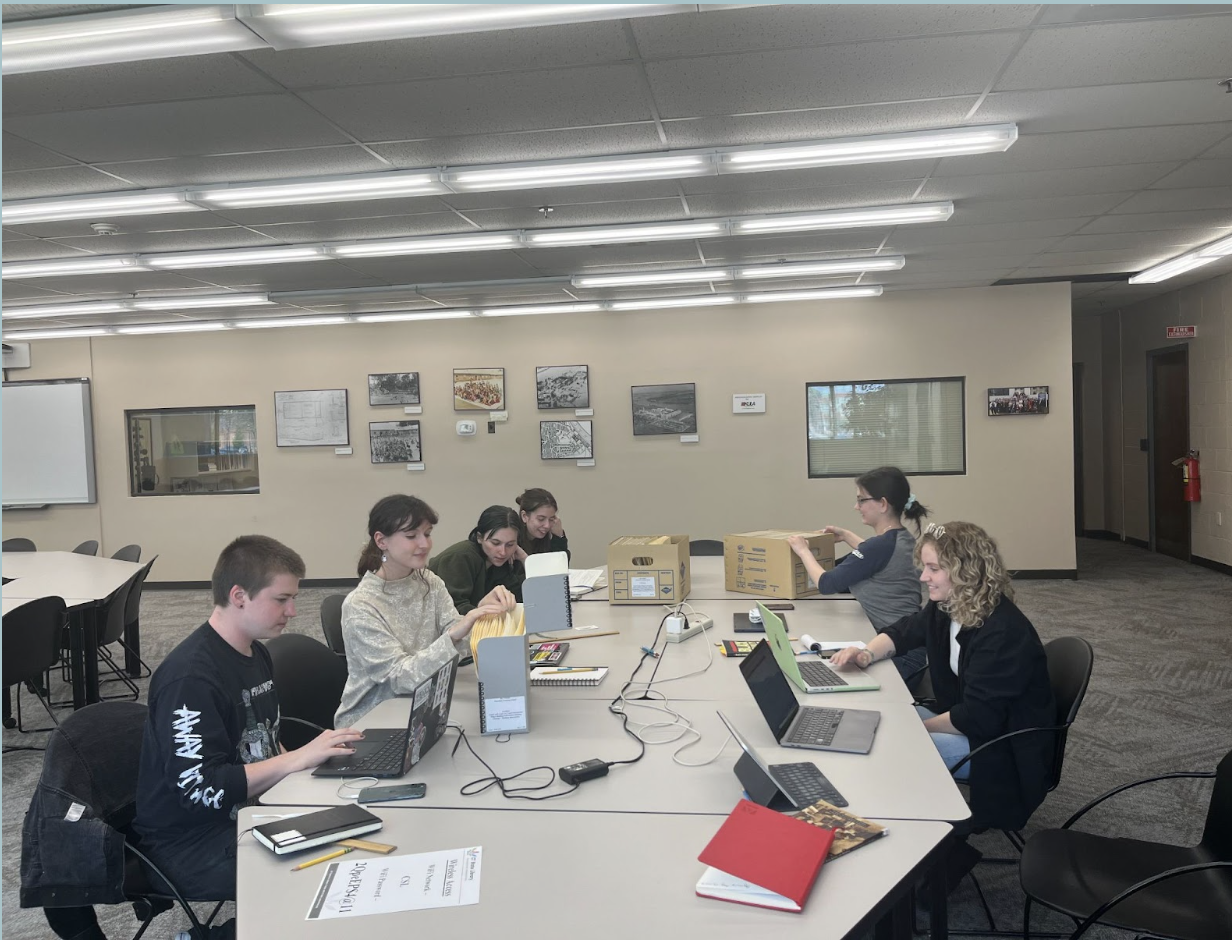
Experiencing the Archives!

Written By Paula Mock

Arriving at the Connecticut State Library (CSL) archival warehouse was incredibly exciting for me (I’m sure if you’d told me a few years ago I’d be excited about archival documents, I’d laugh!). Meeting our MTS team that I’d only met on Zoom so far was strangely cathartic–even though we’d only met a couple of times, I felt (and still feel!) that this is a team made up of particularly kind and diligent people. The lingering anxieties that I had about failing to do the project justice were eased, especially as we entered the library and sat down in front of the boxes.

The daunting task of unearthing and methodically going through each of the thick bins of folders was one that I was fairly well-prepared for. During high school, I’d spent many of my afternoons and weekends at the Peabody Museum in New Haven, creating digestible science content for all age ranges. I’d had some practice with research and curation/selection of documents, especially when it comes to parsing out the most important and crucial information to bring out and amplify to a wider audience. These collection and research skills came in very handy in the CSL as we worked in pairs to make our way through as many boxes as we could. The experience of individually reading documents and then coming together to share particularly striking pieces was one that allowed conversation to spark at any point during the day–numerous times, we found ourselves having had  long, rich discussions about much larger-scale issues than just MTS itself.

Group working on uncovering and examining Mansfield Training School documents
From left to right: Ashten, Paula, Ally, Madison, Lily, and Jess working on uncovering and examining Mansfield Training School documents in the Connecticut State Library archives.  24 May 2023

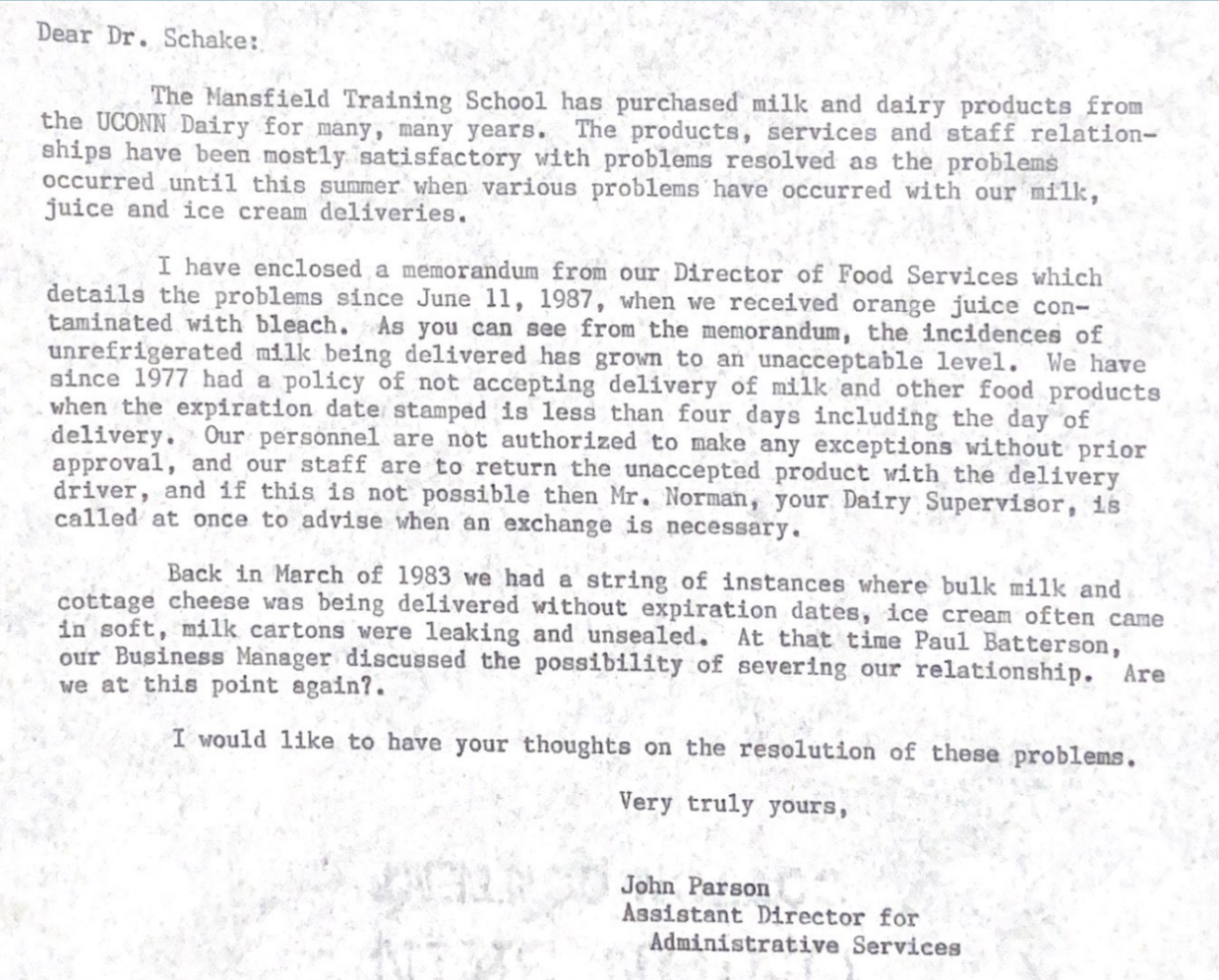
One afternoon, I remember taking what we expected to be a “quick snack break,” all of us moving to a table away from the archival boxes and sitting around, musing over what we’d just seen. One of us (it’s hard to recall who, since we all took turns sharing out!) started the conversation with disbelief about a document they’d just looked over, and we collectively tried to wrap our heads around the implications of what we’d read and heard. Orange juice had been found to be laced with dangerous contaminants, and milk delivered from UConn’s dairy farm already spoiled and warm, and when faced with this information, UConn’s response had been to refrigerate the milk and juice cartons again, and present them later to MTS as if new.

This is a scanned photo of a letter
This is a scanned photo of a letter from John Parson, the assistant director for administrative services, to Dr. Schake, a representative from UConn’s dairy department. Mr. Parson describes the state of the deliveries that MTS has received as of late (bleach contaminants found in the orange juice, and spoiled milk at high temperatures) and requests to speak with Dr. Schake about the matter.

This document and incident spurred an extensive group discussion about everything from food safety, to infantilizing members of our society who have different abilities, to  institutional responsibilities and justice–we must’ve talked for about an hour, but it felt as quick as fifteen minutes to me; I felt so immersed in what others were sharing, and it seemed like the rest of the team felt the same way. There was much jumping around from topic to topic–when one person made an observation, it jarred another person’s memory of another related experience, and then others would jump in as well. 

The energetic nature of the conversation was something that I’ve only been a part of in a few other academic settings, and it reminded me of a concept introduced to me in a sociology class at UConn last year: the “flow state,” one of complete focus that is only possible when fully immersed and concentrated on the current task. For a group of seven, I think it’s pretty remarkable that, from what I could tell, all of us in the room that day were so engaged in each other’s thoughts (and the material at hand) that we were able to completely “plug in” to the more-than-challenging conversation and feed off of each other’s ideas. 

MTS Team Live Reading: “The Mansfield Training School Is Closed: The Swamp Has Been Finally Drained” by Roger D. MacNamara

The following is a slide show presentation of a live reading of Superintendent MacNamara’s 1994 article on the closing of Mansfield Training School. To interact with this piece, please click the embedded link below, select the audio button in the upper left-hand corner to begin the audio, and click through the piece to see the text from the readers.

https://docs.google.com/presentation/d/e/2PACX-1vQ3ZS6lgU2lUcCZ4pLl8JJ8zwiWUMFiEOm5BbOllVeGgPAYwPU3W4aVY-HIjHKcNmBR_aXV0lZC9hLV/embed?start=false&loop=false&delayms=3000&slide=id.p

Places of Waiting

Written By Ashten Carter

[Visual Description: A collage composed of both digital and physical materials. In the center of the collage is the blueprint for the basement of Knight Hospital, with a red “You Are Here” pin placed in the hallway between the waiting room and the mortuary. Surrounding this map are ink drawings that I doodled in my notebook while reflecting on the archives, crumpled pieces of paper, and photographs taken of the inside of the Longley School, and Superintendent’s House on site at Mansfield Training School. The oppressive mint green of the walls frames the collage, alongside images of manila folders, wooden rulers, metal paper clips, clocks, and climbing ivy. In the top left corner there is a photograph of the restraint logs found at the state archives. In the bottom right corner, there is a Massachusetts ruling about the treatment of those who die in institutions. The background of the collage is a textured mess of brick and paint and scribbles alongside redacted documentation.]
[Visual Description: A collage composed of both digital and physical materials. In the center of the collage is the blueprint for the basement of Knight Hospital, with a red “You Are Here” pin placed in the hallway between the waiting room and the mortuary. Surrounding this map are ink drawings that I doodled in my notebook while reflecting on the archives, crumpled pieces of paper, and photographs taken of the inside of the Longley School, and Superintendent’s House on site at Mansfield Training School. The oppressive mint green of the walls frames the collage, alongside images of manila folders, wooden rulers, metal paper clips, clocks, and climbing ivy. In the top left corner there is a photograph of the restraint logs found at the state archives. In the bottom right corner, there is a Massachusetts ruling about the treatment of those who die in institutions. The background of the collage is a textured mess of brick and paint and scribbles alongside redacted documentation.]

The floorplan was not the most remarkable thing that I saw in the archives. At first glance, there was nothing extraordinary about the basement of Knight Hospital. This was not like the documents that puzzled me, the images that startled me, and the narratives that captivated me. Yet, this blueprint was the piece that stuck with me. I suppose that is because there was no room (literal or figurative)  for interpretation. It was a floor plan. There was supposedly no reading between the lines. There was no speculating about who created it, or how they must have felt, or why. It was objective, unlike so many of the documents we had spent the summer combing through. There was the boiler room, the clinics, the bathrooms, the storage room, the lab, the corridors, wheelchair ramps, the stairways, the garbage shed all neatly outlined and labeled. Precise down to the measurements.

And then there was the waiting room right next to the mortuary. 

Holding that paper in my hand is not a feeling that I’ll soon forget. It was as though time stood still for a moment. And in a way it had. I was imagining being in a place of “waiting.” A place where time stood still. 

How would it have felt to be sitting in those chairs? 

What did it feel like coming into the hospital from the dorms? 

Would they tell you why you were there? 

How would it feel to leave the clinic, knowing no one ever returned from the door just down the hall?

How many friends had they lost while interned by the state? 

What were their names? 

Where are they buried?

Institutionalization reminds me of that waiting room. Institutions have historically been a place to hide away society’s “undesirables.”  To the general public,  there’s an “out of sight, out of mind” approach to those who are institutionalized. It’s why we find these facilities in such remote areas. It makes it easier to forget about the people that were already forgotten. However, for those who live in institutions, there is no putting it out of your mind. 

Mansfield Training School was an influential institution, a contributor to the local economy, and “the only option” for many Disabled people and their families. It was also a warehousing operation; it was a “place of waiting.” It, like other institutions of its kind, was where you went to die. 

Just as much as I wondered what it would be like to sit in that waiting room while the facility was in operation, I couldn’t help but wonder what it would be like now. 

What color is the peeling paint? 

What would it be like to see the records of former residents strewn across the floor? 

30 years after the closure of Mansfield Training School, Knight Hospital stands overgrown and decaying. The records stored in that same basement have been deemed ‘irretrievable.’ While institutionalized, the residents’ stories were kept hidden from the outside world. Even now that the institution has closed, their stories remain untold. 

Waiting is the very nature of being institutionalized. We wait for funding for community-based options. We wait to hear from family, if we have any. We wait for the next meal or the next way to pass the time. Sometimes, time passes us. 

Many residents spent decades of their lives at Mansfield Training School, an institution that claimed to specialize in caring for those with disabilities. In actuality, institutions like MTS specialized in waiting. 

Did the residents of MTS know the waiting room is for the clinic?

Did they fear that it just as easily may have been for the morgue?

A photo of the blueprint of the basement of Knight Hospital. The paper is textured and off white, and the floor plan is outlined in purple-ish blue ink.]
[Visual Description: A photo of the blueprint of the basement of Knight Hospital. The paper is textured and off white, and the floor plan is outlined in purple-ish blue ink.]

In the Archives…

Written By Dr. Brenda Brueggemann

I’m not a very patient person and my attention span has some challenges since I’m always thinking of (way too many) projects and ideas at any one moment.  And so:  I’m not a Good Person in the Archives.

I knew that already about myself.  I had tried it before with numerous (significant and scintillating but still abandoned) Deaf studies/history projects in the past.  Sure, I’m trained with a PhD in the philosophy, theory, and practice of the ancient art of Rhetoric,  So, in essence, I had all the “basic skills” to do this kind of work. On paper.  

But my imagination has always wanted to overtake the archives, to fuss with the fact-finding, and to dog the detailed and deliberate march through The Records in pursuit of Historical Truths.  I would always get impatient and distracted, my storytelling self taking over the driver’s seat down the archives highway, eating up the rest of the bag of chips.  

Being in and “doing” the MTS archival work was hard on me then, needless to say.

I was cold in there – all the time.  Both physically and probably also a little spiritually.  The air conditioning was overwhelming in the summer and then dead-air damp chill saturated the space in the winter. The closed-in feeling was quite claustrophobic. The Connecticut State Library (CSL) archivists were watching us all the time –and that surveillance rubbed on my edges.  My mind wandered, a lot. I couldn’t stop thinking about:  the chocolate peanut butter granola protein bar I’d left in my backpack at  the locker outside the archives; or the abandoned deli in the corner of our window view at the Connecticut State Library Archives warehouse location in near-downtown Hartford, CT. (possibilities of a good grilled cheese sandwich haunted me at every visit); or the red comb someone had left in the bathroom there (that had now been there for over a year of our visits); or the Colt Gun Factory exhibit on the CSL Archives meeting room wall;  or the rickety-rickety old school rolling-fenced gate that chugged its way  back, so very slowly, to let us into the dilapidated and patchy asphalt “parking lot” at the archives; or the parents and kids at the school right next to the archives building who convened for pickup in mid-afternoon (and wouldn’t then allow us exit from the archives at that time).  I was distracted.

But then again, I wasn’t.  I was also finely focused, riveted, operating on High Purpose.  

I reveled in (and largely remembered) the remarkable details of almost every team conversation we had within the CSL Archives.  I came to know everyone’s favorite snack options.  The community we created in the archives –doing this work, together, and troubled, and important, and a little terrified – these are the things I most take away from (and with) it. 

Why I’m Here -Brenda

I’m here, on and in this project, because I simply couldn’t not be.  I didn’t choose the project (like many of the fabulous undergraduate research team members did) – it chose me.

I had done some other community-related disability advocacy and activism work in Ohio (while on the faculty at Ohio State University for 21 years) and in Kentucky (while also on the faculty at the University of Louisville for 3 years). But those were more containable projects with goals and known limits and ends.  (See: Voices Together: The Art as Memory Project) 

The MTS Memorial and Museum @ UConn Project is far bigger and more unknown than any of those previous projects I’ve encountered and engaged in.  The MTS Project is a case of “research” finding me –  rather than me setting out on a predetermined research path.  It’s something like “research at first sight” (akin to “love at first sight”) where I was utterly swept off my feet and then the project just overtook me.  

And yes, that’s a little complicated and icky too.  Love and research can be like that.

I wasn’t expecting to take on such a large-scale, deep, wide, troubling, meaningful project at this stage in my fairly long academic career.  I was thinking more about coasting into a couple of grand finale style essays and invited cameos for my last years as an academic – with 25 years now in the field of Disability Studies.  But then:  Jess and I literally fell into this project with a half-hour independent study conversation in my office late in September 2021. The world kind of flipped over on that day for me.

I am a disability studies scholar – and a disabled person – for my lifelong academic career.  I am of the “first generation” of such folx in higher education.  The MTS project brings together the best of the skills and things I’ve worked on, worked towards, advocated for, and taught about in my 30-year faculty career:  

  • carrying out advocacy that is based on community; 
  • engaging disability rights activism that blends study with struggle, education with the public; 
  • re-telling and excavating buried disability history/ies; 
  • combining archival research with narrative techniques and analysis; 
  • working closely with student researchers and writers to learn, create, grow through the material together

I’m home.  I’m here. 

My Time at the Archives

Written By Ally LeMaster

When I think back to the archives, I think about the hazy lighting.

How the documents were lit up by sterile fixtures. The whole building seemed muted, except for the latex-free, oversized green gloves. 

After hours of pouring over archives, my hands felt like a layer of the past rubbed off on my fingers— that somehow the particles in the air at Mansfield Training School carried from all these years to end up in the present. 

I remember the smell of the old transfer paper and wondered if that’s the scent that perforated MTS too.  

Mildew and must. 

I wanted to know who touched the papers before me and what their hands did before and after. Were their hands healing? 

Did they cause harm? 

Or were their hands simply bystanders to horrors that went on there?

I remember trying to stop myself from asking questions that could never be answered. Just to stick to words written on the paper in front of me.  

But there were still questions on top of questions. 

I remember combing through every single document because I was scared to miss the important detail. Like if I read every single word, I could actually make sense of what happened.  But I couldn’t find those words because sometimes actions won’t always have meaning behind them. 

I would always catch myself looking up at the face of the archivists. How they talked firmly about the present, but the research team was sunken deep in the past. 

Mostly, I think back to the relief and worry that went through me when it was time to leave. 

In the archives, you absorb almost a decade’s worth of information in a day and have to go back home to a false sense of normalcy. I remember how my days in the archives stuck to me like the embrace of a shrunken sweater.

I’d pull up to my house exhausted. 

My dad would ask me how my day at the archives went. 

Every detail of every document swarmed my head, from the restraint logs to employee guidebooks. The sad, the grim, and the troublesome stories told in the archives were always at the tip of tongue. 

But I knew I had to pull away from the question. I didn’t want the information to haunt him like it did me. 

“My day at the archives was good, Dad.”

And I’d go to my room as if nothing ever happened.  

Taking in the Archives…

Written By Ashten Carter

When I first found out about Mansfield Training School, I felt a calling. Frustratingly, there was not much information I was able to gather on the facility’s history. When I googled Mansfield Training School, the historical information was overshadowed by results containing phrases like “Insane Asylum,” “Most Terrifying Abandoned Psychiatric Hospital,” “Scariest Place in Mansfield,” and “Paranormal.” Perhaps the one word I saw the most was the word “haunted.” Google assumed I wanted a ghost story, and hawked the now defunct institution as one of “The 8 Most Haunted Places in Connecticut,” or claiming it to be a “Haunted Asylum from Hell.”

I felt as though I was coming up empty, except for the bitterness I felt crawling up my throat. I did not want to be sold a sensational story. It felt exploitative and disingenuous. The institution only closed 30 years ago but it was starting to seem that the humanity of the site had crumbled away, or peeled off with the paint. More accurately, Mansfield Training School’s clinical environment was further sterilized by the act of forgetting. It was easier for the public to grapple with the ruins of the “Depot Campus” if they could call it haunted. Most people did not want a glaring reminder of what happened there. Maybe they wanted to rationalize away the hurt. When this reconciliation could not be done, maybe they turned to forgetting. Perhaps it was a community’s wounded attempt at understanding a site of harm.

Macabre fascination was not what drew me to the project. In fact, it was quite the opposite. I wanted to learn the history and see the buildings, to know the residents and the administration. I was searching for kinship with people I would likely never meet. That’s what led me to the archives. When Jess and Brenda gave a presentation on research they had done on Mansfield Training School, I was overcome with curiosity. I had the opportunity to ask questions and realized I had more questions than I could have imagined. I wanted to absorb everything that I could. So when the chance came to visit the Connecticut State Library, I was…. excited? Is excited the right word? Does it matter if it is fear or excitement if they both ache the same way in your chest? 

Brenda and Lily were kind enough to give me rides to and from the archives. Our commutes to Hartford were usually filled with apprehension and caffeine. The rides back were consumed with exhausted reflection. Under the guidance of the archivists, we were able to get glimpses of MTS. Pouring over the documents and photographs in the archives was an experience unlike any other. We found a need to comb through everything we could get our hands on, and piece together snippets of narrative where we could. There was a hunger, a desire to take in as much as we could during the limited time we had to spend, even when the material was difficult to read. It was as if we held our breath for the chance at accessing information that may let us better understand the weight of the information. And once we were finally able to exhale, we did so over snacks and conversation. We shared thoughts, questions, jokes, chocolate bars, and stories. The archives were intimidating, but the research team was always sweet and supportive of one another. Even though our team was only able to meet in person a handful of times during the summer, it was unforgettable to share that time and space. I was seeking kinship between the lines of documentation and pressed between manila folders. I found it in fruit snacks, pet photos, doodles, and carpools.

Still, there was the matter of access. Mansfield Training School was so close to where we live and work. Its history impacts many features of the local area today, and yet we had almost no access to information as members of the public. Frankly, we may not have been able to determine where to look without the resources and connections provided by the university. If not for the opportunity to take in the archives, we would only know Mansfield Training School through the videos uploaded to youtube by self-proclaimed urban explorers and paranormal enthusiasts. 

That is why experiencing the archives was so captivating and so vital to the mission of our project. We maintained the goal of creating access to the information. In all its mess, with all its nuance and complexity. No sensational “ghost stories” or “haunted tales” to explain what we can’t understand. We would not assist in the collective forgetting of Mansfield Training School, just as many other community members who remain impacted by what happened there. We found many versions of Mansfield Training School and its key figures throughout the 133-year reign. It doesn’t take courage to call a place haunted or create an attraction out of a site of great pain. The truly brave feat is in digging deeper, asking “why?” and grappling with what you may find. 

The Paper Trail of Charitable Giving: Implications of Donation, Benevolence, and Gratitude in the Institutional Setting

Written by Madison Bigelow

By the time I arrived at the Connecticut State Archives warehouse for the first time to begin my work on the MTS Memorial Project, I had already formed a number of expectations as to what I might see kept in those boxes (which included, but were not limited to: government proceedings regarding the institution’s closure in 1993, lots of grainy, black and white photos, and tons of carework guidelines for the facility’s employees). What I didn’t expect, though, was to be handed a box filled with several hundred donation receipts that were maintained throughout the 60s.

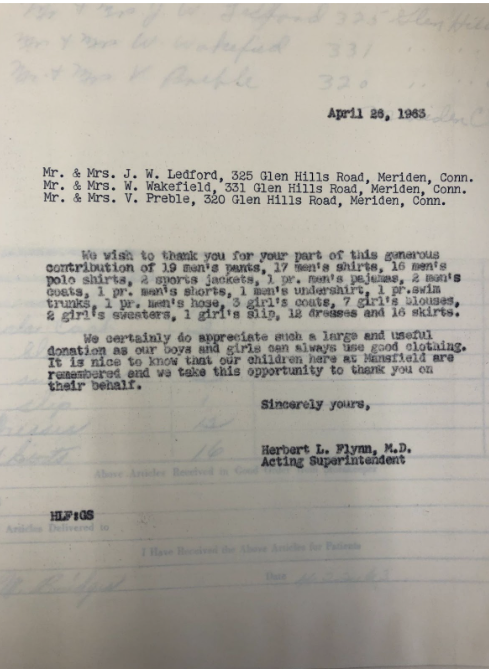
In reality, these receipts took the form of letters. In each document, the letter addressed the donor, thanked them for their contribution(s) to Mansfield, explicitly made note of each item and its quantity that was received, and assured the donor that their gifts will be greatly appreciated by the ‘boys and girls’ of MTS. 

Above is a ‘thank you’ receipt, dated April 25, 1963. The header addresses a Mr. and Mrs. J. W. Leford, a Mr. and Mrs. W. Wakefield, and a Mr. and Mrs. V. Preble, all of Meriden, Connecticut. Signed by Superintendent Flynn, the letter thanks these couples for the donation of 19 men’s pants, 17 men’s shirts, 16 men’s polo shirts, 4 sports jackets, 1 pair of men’s pajamas, 2 men’s coats, 1 pair of men’s shorts, 1 men’s undershirts, 1 pair of swim trunks, 1 pair of men’s hose, 3 girl’s coats, 7 girl’s blouses, 2 girl’s sweaters, 1 girl’s slip, 18 dresses, and 16 skirts. 

The last paragraph, which appears in some iteration across every receipt we found in the archives, states: “We certainly do appreciate such a large and useful donation as our boys and girls can always use good clothing. It is nice to know that our children here at Mansfield are remembered and we take this opportunity to thank you on their behalf.”

These thank you letters offer an interesting window into the life of an MTS resident during the 60s at first glance. However, the more receipts I uncovered, the more questions arose. For instance, I am still attempting to understand why we – historians, archivists, scholars – have these documents. Why were these letters kept by the MTS administration in such detail? And only for these years? Why do these letters seem to only have been written in a very small time frame? And what does this mean for the legacy of MTS? For institutional legacies at large? 

Perhaps the archivists that went on-site at Mansfield to collect these ‘lost’ documents in ~2010 were only able to salvage a portion of the donation receipts that were produced by the MTS administration. We do know for certain that there are still many artifacts left on the floors of the Mansfield campus buildings deemed forever ‘irretrievable’ as per the state of Connecticut. Considering that the archived letters we do have access to, though, were all written within the same X YEAR span with no temporal outliers, it feels safe to assume that this clerical venture was only a short blip in MTS’ much longer history.

Despite this being such a small blip in MTS’s greater legacy, the insights that these documents offer are potentially quite valuable to understanding institutional functionality in the 20th century. 

As Paul K. Longmore writes in Telethons: Spectacle, Disability, and the Business of Charity, “in order for givers to have regular occasions on which to ritually reassure themselves of their moral health and social validity, it was necessary to perpetuate the social and moral invalidation of people with disabilities” (83). I do not seek to diminish the kindness of the said ‘givers’ in question, nor the assumed benefits that residents of MTS reaped as a result of these donations, but I rather aim to question: why do these records exist to such minute specificity? One possible answer to this question is promoted by Longmore’s observations about the American Telethon; the paper trail of charitable donation aims to continually affirm differences that exist between members of an institution and its counterparts on the outside. In other words, letters built a paper bridge that connected the interior world of MTS and the town of Mansfield on its periphery. 

By this logic, these “thank you” notes are a physical receipt of performed benevolence. Since residents were regarded as incapable, incompetent, immoral, or otherwise just underserved by their institution, giving becomes an act of distance. The donation of used goods creates space between residents and community members and subsequently justified social, economic, and spatial power dynamics that further insulate training schools, writ large, from the greater towns they are a part of. 

Thus, understood in Mansfield’s context, Longmore’s argument that “perennial [objectification] of charity in order to reassure putatively normal Americans of their own individual moral health, [and] of the continued vibrancy of the American moral community” rings true (83). This distance validates feelings of moral superiority and indicates that, as a part of this performance of benevolence, such tight recordkeeping was encouraged by Mansfield’s administration, if only for a small window of time. 

In addition to items of ‘utility,’ like clothing, bedding, and toys, there was definitely an element of absurdity present in some of these donations. For instance, there was more than one letter that detailed large quantities (usually in the triple digits) of Hostess cupcakes being received by MTS for the ‘boys and girls.’ Surprisingly, there were also many fur coats received by the institution. 

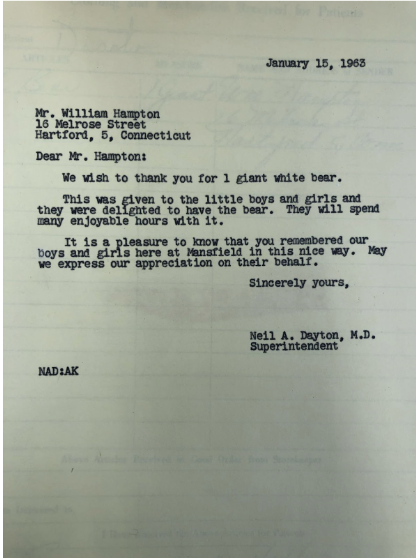
This letter, dated January 19, 1963, acknowledges the donation of a single “giant white bear.” How were items like this given to the ‘children’ of Mansfield? Were they kept in a playroom? Assigned to a single dormitory? An individual person? Unfortunately, without further record keeping that details the distribution and use of such items, we are left to imagine how MTS’ internal donations economy functioned on the day-to-day.

Writing these ‘thank you’s’ to Mansfield’s donors indicates a few things. For one, there was one point in time that this clerical gratitude was valued so highly at Mansfield as to itemize each component of a person’s donation (however, we have little knowledge as to how these donations were distributed or shared). Additionally, we know that at least some of these letters were read to members of an organization if the donation was made in the name of a group.

As is general knowledge, Mansfield, like most public institutions, were severely underfunded. To some extent, it is safe to assume that MTS was partially reliant on donations. Again, this piece does not aim to argue that the donations made were not valuable, but rather examine the underlying motives and implications of a person to donate to MTS, and for MTS to record those details in (cheerful) extremity. 

So… what do we do with this information? Frankly, box no. 31 raised more questions than answers for me about the underbelly of MTS. How were these items actually used by residents? Were these all of the donations? Did donations to MTS cease in the years following this recordkeeping? Or do these letters indicate the origins of the UConn Foundation?

As we continue this excavation, hopefully the rhyme behind the reasoning for keeping records like these will become more clear. 

To Abandon is to Forget

Written By Lillian Stockford

The abandonment of a place is the abandonment of its memory. When UConn acquired the land of the Mansfield Training School it also became one of the holders of its history. They have since left the memory to rot in the minds of the community and allowed the buildings of the campus to fall to pieces. They left records to decay on the floor of the Knight Hospital and we will never know what those records said or what pieces of the puzzle they could have provided. Instead, those abandoned documents had to be deemed irrecoverable after sitting for almost 30 years, from the closing of MTS in April 1993 to the spring of 2021. This disrespect of the documents is indicative of the larger trend concerning the property itself –and by extension, a grave disrespect for all the people who resided and worked there. Trees grow out from the underside of the buildings, rooms remain with fire damage, and fenced-off buildings are full of asbestos. An overall sense of desertion hangs over the campus.